
Is Seven Figures Really Attainable for a Wedding Pro?

Seven figures in a wedding business is a math problem, not a mystery. Divide your revenue goal by your average ticket to get the events you need, divide that by your conversion rate to get required inquiries, then compare it to the leads you already get. Most pros are closer than they think.
You keep asking if a million dollars is possible. That is the wrong question.
When I ask wedding pros if they believe seven figures is a real destination for them, most people fall into one of three camps. There are the pros who have decided it is possible for someone in a bigger market or a bigger city, but not for them. There are the pros who think it is possible but only if they rebrand, rebuild the team, or get some viral moment they do not have yet. And then there are the pros chasing it with more marketing, more weddings, more hours, trusting that harder will eventually get them there.
I want to hand you a completely different way to look at this. A math way. Because when you see seven figures as a math problem instead of a concept, the question stops being “is it possible” and starts being “here is exactly what it would take, and here is where I stand right now.” That shift changes everything about where you point your energy this year.
Can You Hit Seven Figures?
Before we run any numbers, I want you to sit with the real question. Not the someday version. The right-now version, in the market you are in, with the clients you have, with the business you have already built.
“They’ve decided somewhere along the way that the ceiling is wherever the ceiling currently is, and they’re making peace with that.”
That is the trap. You look at where you are, you assume that is the limit, and you quietly stop asking what the business is capable of. The pros who break through are not the ones with a bigger city or a luckier break. They are the ones who stop treating the number as a feeling and start treating it as an equation they can solve.
Case Study Growth Arc
Let me walk you through a real one. I have been coaching a wedding planner for just over two years. She came to us in the fall of 2024 making about $120,000 a year. She was not failing and she was not in crisis. She had a real client base, a good reputation, and a business that worked. The problem was that it worked because of her, and only because of her.
“Her team made the volume survivable, but they didn’t make her any less essential.”
Here is the arc, and the arc is the key. In 2023 she did $120K. In 2024 she did $228K. In 2025 she did a little more than $400,000. This year, in 2026, she is tracking just over $600,000. Four straight years of growth, and more than four times the revenue she was doing when she started.
There was no reset, no rebrand, no move to a new city, and no shiny new service. Same business, same craft, same market. What changed was a series of decisions made in the right order over time, each one building on the last. The pros who scale the fastest are the ones who listen to what the data is telling them and then take massive action on it, even when the next move feels scary.
We can hand you every ounce of strategy you need to scale. If you never take the action, it falls flat.
3 Moves to Scale
Three moves took her from $120K to almost quadruple that. The first was pricing, and I want to be specific because this was not about raising her rates. She changed the entire structure of how she charged. She came in on a flat fee for full planning, one set number no matter the wedding budget. A couple spending $60,000 and a couple spending $250,000 generated the exact same planning fee.
A $250,000 wedding is not a bigger version of a $60,000 wedding. More vendors, more complex logistics, a longer timeline, higher expectations at every stage. When you charge a flat fee, you absorb all of that difference for free, and you feel it in the accumulation. So we moved her to percentage-based pricing tied to the total budget and the scope of the event.
“Her average full service wedding went from 10K to now over 18K on average, and some as high as 30 or 35K.”
That one structural change did something bigger than raise a number. It let her revenue scale with the caliber of client instead of just the volume of weddings, and it let her keep serving the market she started with while she grew into higher budgets.
The second move was the consultation and the follow-up, and this one surfaced about a year in. Her sales were good, but her booking rate was not where it should be. She was getting more than enough consultations, and they felt great, but contracts were going out and not coming back. There was no dedicated system for staying in the conversation, so leads faded.
So we built a weekly block into her calendar just for personal follow-up. Not an automation, not a drip sequence, not a template. A quick voice note about something she saw that would work at their venue. A fun text to a couple she knew was touring venues that weekend. We also changed how her consultations end. Every call now closes on a clear, agreed next step, never a vague “feel free to reach out.” Her booking rate started to move almost immediately.
- Personal, specific outreach to warm leads on a set weekly block
- Every consultation ends on a clear, mutually agreed next step
- No vague endings, no leads left to quietly go cold
The third move was the team, and it is the one that looks obvious from the outside and feels impossible from the inside. She came in with contractors who executed the work she set up. Contractors do what they are asked. What they do not do is own outcomes. Over two years she rebuilt the team from the ground up.
“Each one was so scary before it was freeing.”
Now she has a full-time director of operations who owns how the work gets done, full-time lead planners who own their own client relationships, a full-time administrative assistant running the inbox and scheduling, and a part-time logistics planner. A few weeks ago she told me she cleaned her apartment and started taking morning walks before opening her laptop. Her job now is managing people and running the numbers, not managing tasks. That is the job you cannot do when you are buried in the execution.
The Million Dollar Math
Here is where it gets fun, because the math is the whole point. She is doing just over 60 events a year, tracking just over $600,000 in revenue. Divide it out and her average ticket is right around $9,800. So the first question I asked her: at that average ticket, how many events would it take to hit a million dollars?
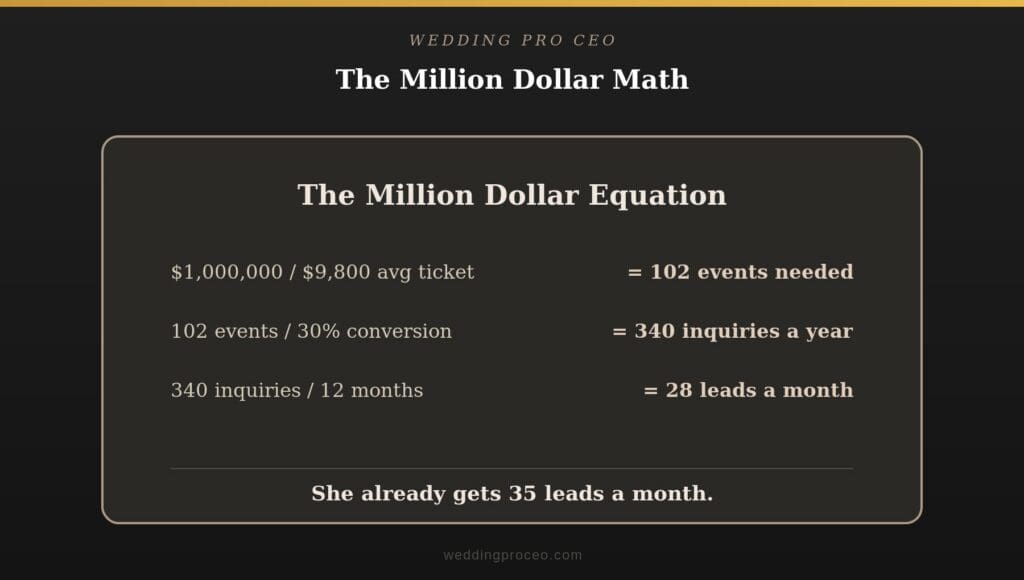
A million divided by $9,800 is 102 events. Her conversion rate from inquiry to signed contract is about 30%, so to land 102 events she needs 340 inquiries for the year. Divide 340 by 12 and she needs 28 inquiries a month. Then we looked at her actual numbers.
“She typically on average gets 35 leads per month, and she only needs 28 at her current average ticket at her current conversion rate to hit a million dollars.”
She was already getting more leads than she needed. There was an audible pause on the call when that landed. She repeated it back to me: “So I only need 28 leads a month, but I already get more than that, so why am I not already hitting a million dollars?” Because this year she was still working through old pricing on the books and building the team. The foundation had to come first before the math could even work.
This is the trap so many wedding pros fall into. Revenue goal goes up, so you assume the marketing effort has to go up. More visibility, more leads, more posting, more ads. But her constraint was never visibility. It was what happens after the consultation. The follow-up, the close rate, the average ticket. Move her conversion from 30% to 35%, which is not dramatic, and grow her ticket by a couple thousand dollars, and she needs even fewer leads. Both are already in motion. She is 36 events away from a million dollars, and now she can see it clearly.
Run Your Numbers Next
Now I want you to do this in your own business. Most wedding pros never have this conversation. They set a revenue goal because it feels ambitious, then they try to hit it by doing more of everything, and when it does not move fast enough they blame marketing. Sometimes that is right. Sometimes, like with her, the leads are already there.
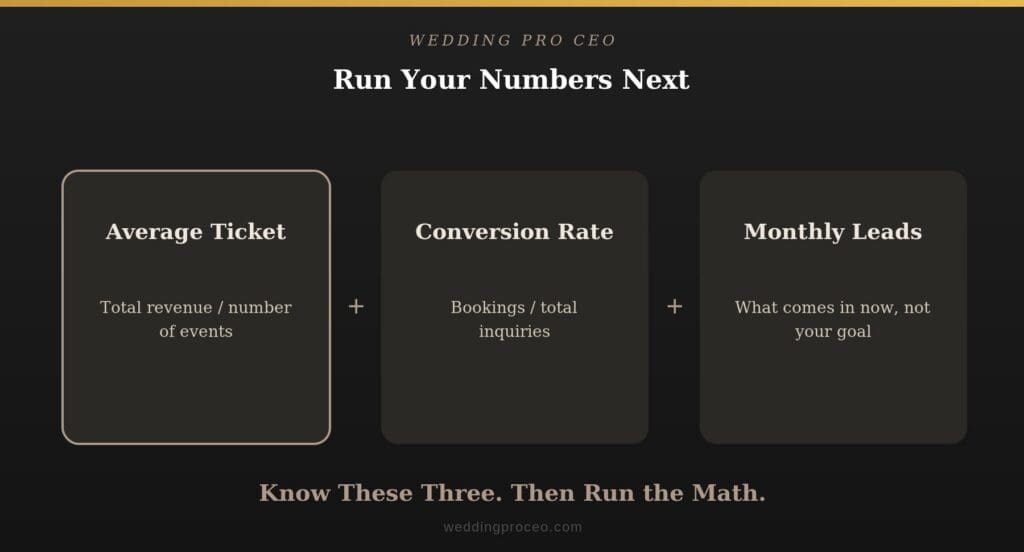
Find three numbers. Your average ticket: total revenue divided by number of events. Your conversion rate: total bookings divided by total inquiries. Your monthly lead volume: what is coming in on average right now, not your goal.
- Revenue goal divided by average ticket equals the events you need
- Events needed divided by conversion rate equals inquiries for the year
- Inquiries for the year divided by 12 equals what you need each month
“Seven figures or really any revenue goal that you set is just a math problem, and a lot of you are so much closer to solving it than you realize.”
Compare your monthly number to what you get. If you are already there, your constraint is conversion, and your energy belongs in the consultation, the contract, and the follow-up. If you are well below it, your constraint is visibility, and your energy belongs in marketing. Either way you now have one specific lever to pull instead of a vague plan to grow. And if you are already hitting your lead target with a strong conversion rate and still short of the goal, the lever is your average ticket, which brings you right back to move one.
Before You Go
If seven figures has always felt like a someday number, I hope today made it feel like an equation instead. You are not waiting on a breakthrough or a lucky market. You are waiting on clarity about which single number is holding you back.
You have built something real. The next level is not about hustling harder in every direction. It is about running the numbers, finding the one constraint, and pointing all of your energy there.
Inside Wedding Pro CEO, this is what we do with our members every day. We look at your real average ticket, your real conversion rate, and your real lead flow, and we map the exact path from where you are to the revenue goal you want, then we build the pricing, sales, and team to support it.
If you want my team to spot the gaps in your business and show you what it looks like to scale with us, book a free Gap Assessment at weddingproceo.com/application.
Come hang out with me on the daily:
- Instagram: @brandeegaar
- TikTok: @brandeegaar
- YouTube: Brandee Gaar
Frequently Asked Questions
Is seven figures attainable for a wedding pro?
Yes, and it is a math problem more than a talent problem. When you know your average ticket, your conversion rate, and your monthly lead volume, you can calculate the exact path to a million dollars and see how close you already are.
How do I calculate how many events I need to hit my revenue goal?
Divide your revenue goal by your average ticket. If your goal is $200,000 and your average ticket is $10,000, you need 20 events. Then divide that by your conversion rate to find the inquiries you need for the year.
What is the difference between flat fee and percentage-based pricing?
A flat fee charges the same amount no matter the wedding budget, so your most complex events generate the same revenue as your simplest ones. Percentage-based pricing ties your fee to the total budget and scope, so your revenue scales with the caliber of the client.
Do I need more leads to grow my wedding business?
Not always. Run your numbers first. If you are already getting more monthly inquiries than your goal requires, your constraint is conversion, not visibility, and pouring more money into marketing only grows a leaky funnel.
How do I know when it is time to raise my prices?
If you are already hitting your monthly lead target, your conversion rate is strong, and you are still short of your revenue goal, the lever to pull is your average ticket. That points you back to your pricing model and the clients you position for.
Why does the foundation have to come before the growth?
Because more volume on a broken pricing model or an understaffed team only burns you out faster. Fix pricing, sales, and team first so the business can hold the capacity, then the math to a million dollars becomes a question of what the business can produce, not what you can survive.
Check out the video version of the podcast below. 👇
Subscribe, comment and share to support the channel.
💌For business inquiries: sayhello@weddingproceo.com
Heads up, CEO! Some of the links I share may be affiliate links, which means I may earn a small commission if you decide to purchase—at no extra cost to you. I only recommend tools and resources I actually use and love, and that I believe will help you grow a profitable, sustainable business you’re obsessed with.
EPISODE NUMBER 351
next post
previous post

© 2021-2026 Wedding Pro CEO | 15502 Stoneybrook West Pkwy, STE 104-206, Winter Garden, FL 34787
+1 (407) 385-8397 | support@weddingproceo.com | Legal | Brand Clarity

